

Enterprise
Permitting software for large local governments.
AI plan review software is a purpose-built tool that helps permitting departments analyze submitted plans, flag missing information, and give reviewers what they need to make faster, more consistent decisions — without replacing their judgment.
It speeds up the most time-consuming parts of plan review by taking on the work that slows reviewers down:
Think of it as a co-pilot. It compiles documents, runs calculations, pulls relevant code sections, and points reviewers to the right places in the plan set. From there, the work shifts back to the reviewer. They stay accountable for making the final call.
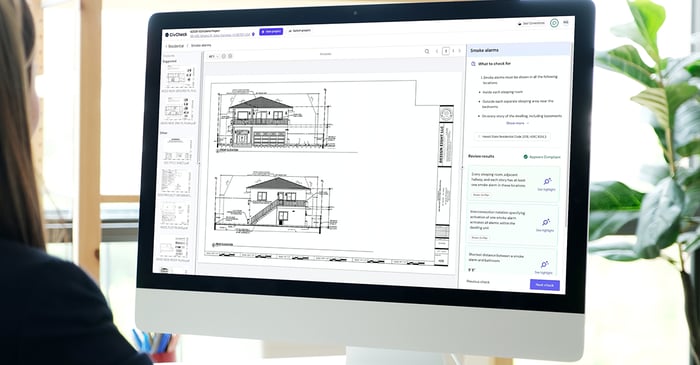
A well-designed platform can drastically cut review time by reducing manual searches, repeated checks, and back-and-forth over missing information.
When staff use AI plan review, it helps reviewers reach decisions faster without replacing their judgment. They still evaluate intent, handle edge cases, and make the final determination. But they're no longer forced to rely on memory, manual searches, or informal practices that vary from person to person.
Many platforms also extend this capability to applicants. The same underlying technology functions as guided permit preparation, helping applicants understand which documents and information are required and flagging issues before they submit. While the system is the same, the experience for applicants and reviewers is intentionally different, because they're solving different problems.
CivCheck, Clariti's AI Guided Plan Review Platform, was designed to provide two genuinely separate experiences—one for the applicant preparing a submission and one for the reviewer evaluating it—instead of giving both sides access to the same interface.
Permitting departments are turning to AI because rising application volumes, staff turnover, and inconsistent review practices are creating backlogs that traditional approaches can't solve.
Permit backlogs aren't a new problem. But the combination of rising application volumes, staff turnover, and inconsistent review practices is pushing more departments to look for a better way to manage the workload.
The challenge isn't only about reducing time-to-issuance; it's about understanding how to address incomplete submissions that are eating up staff time before a plan reviewer ever evaluates code compliance. Review practices vary from person to person, and standardization efforts aren't always applied consistently. When experienced reviewers move on to new roles or retire, the institutional knowledge they carried often goes with them.
AI plan review is gaining traction because it addresses these problems directly. This type of software improves submission quality before applications enter formal review, giving reviewers the information they need to make faster decisions, and helping new staff get up to speed more quickly.
To see what makes AI plan review software different, it helps to compare it to other tools in the market.
Not all AI tools in permitting solve the same problem, and using the wrong one won't reduce your backlog. Test-fit tools, permit guides, code compliance checkers, and true AI plan review software all get marketed under the same label, but they serve fundamentally different purposes.
A tool designed to answer "What can be built on this parcel?" solves a different problem than one designed to answer "Is this project ready to be permitted?" Very different tools get grouped under the same "AI plan review" label in the marketplace, and understanding those distinctions makes it easier to avoid investing in something that looks great in a demo but doesn't address the actual cause of your permitting delays.
What they do: Help developers and designers answer early-stage questions like: What can be built on this parcel? These tools often take BIM/IFC files and use GIS + parcel data to model zoning envelopes, setbacks, height limits, and other massing constraints.
Good for: Municipalities with significant new development that want to give developers clearer answers about what's buildable and reduce zoning-envelope questions.
Limitations:
The bottom line: These are planning tools, not permitting tools. If permit review timelines or application quality are the problem, a test-fit solution won't move the needle.
Examples: Archistar, UrbanForm
What they do: Help applicants understand which permits they need and what's required to apply. They typically ask a series of questions and generate instructions, checklists, and sometimes fee estimates based on the applicant's responses.
Good for: Jurisdictions where applicants pick the wrong permit type, staff are fielding many basic "where do I start?" questions, or intake teams spend time correcting preventable submission errors. Can reduce counter visits, calls, and emails.
Limitations:
The bottom line: Permit guides can improve applicant understanding, but they're not a substitute for plan review support. If low-quality submissions and long review cycles drive delays, a guide alone won't solve the problem.
Examples: Clariti Guide, OpenCounter
What they do: Built for architects and engineers during the design phase. Many code compliance tools integrate into design software and help check specific parts of a design against select code requirements.
Good for: Helping designers catch errors before submission.
Limitations:
The bottom line: Automated code compliance tools answer "Is this design compliant?" — which is not the question plan reviewers need to answer. Permit documents serve as the legal record, and plan reviewers need to verify that compliance is shown in those documents.
Examples: CodeComply
What it does: Designed specifically to support permitting workflows. It analyzes submitted plans and application materials to confirm required documents are present, verify that key information appears in the plan set, and shows where compliance is demonstrated (or where gaps exist). It pulls relevant code sections, performs calculations, and points reviewers to the exact locations in the plans where applicants addressed those requirements.
Good for: Jurisdictions where review capacity can't keep up with application volume, where submission quality is driving correction cycles, or where staff turnover makes it hard to maintain consistency.
Limitations:
The bottom line: This is the category that can directly reduce review time and correction cycles. The most effective platforms act as a co-pilot, handling information gathering so reviewers can focus on decision-making.
Examples: CivCheck
CivCheck supports both intake and detailed plan review within a single platform, so departments can address submission quality and review efficiency together. It's built to work with PDF plan sets so that applicants can upload standard permit documents without reformatting or manual tagging. With 97% code interpretation accuracy and 99% of code book coverage, the platform supports building and planning checks and is configured to reflect local amendments and jurisdiction-specific practices.
| Tool type | Primary purpose | Who it's for | What it helps with | What it doesn't do |
|---|---|---|---|---|
| Test-fit / massing tools | Explore what can be built on a parcel | Developers, planners | Early-stage feasibility, zoning envelopes | Reduce permit review time or validate permit readiness |
| Permit guides | Help applicants understand requirements | Applicants, permit counters | Identifying required permits, documents, and fees | Analyze plans or support detailed plan review |
| Automated code compliance tools | Validate designs during drafting | Architects, engineers | Catching select design issues early | Reflect local review practices or handle PDF-based plan sets well |
| AI permit intake tools | Improve submission quality at intake | Applicants, intake staff | Checking document completeness and basic information | Perform full plan reviews or detailed code analysis |
| AI plan review software | Support permit decision-making | Plan reviewers, departments | Finding required info, verifying compliance, reducing review cycles | Replace professional judgment or automate permit approvals |
AI plan review software reduces review time and improves submission quality, but it has real limits that are worth understanding before you buy.
Even the best AI plan review platforms have limits. Being clear about them upfront helps set realistic expectations and avoids investing in a solution that isn't matched to your organization's problem.
Not every jurisdiction needs AI plan review software. The strongest ROI comes when permit volume, staffing constraints, and submission quality issues converge — and the honest first step is to assess your readiness.
AI plan review is a powerful tool, but its ROI depends heavily on overall readiness, including where your permitting process breaks down and whether the scale of the problem justifies the investment.
| Signs your department may be ready | When it makes sense to wait |
|---|---|
|
|
Most jurisdictions start with permit intake and expand from there. AI plan review use cases follow a predictable progression based on volume, risk, and readiness, and the entry point is almost always the part of the process where incomplete submissions are causing the most delays.
Adoption rarely happens all at once. Use cases tend to expand gradually as teams get comfortable with the technology and start to see where it fits into their existing processes. The industry is always evolving, and use cases tend to follow a predictable progression based on volume, risk, and readiness.
For many jurisdictions, the highest-impact starting point is permit intake. This phase is also where CivCheck customers usually start.
Incomplete or low-quality submissions create work long before a plan reviewer ever evaluates code compliance, and they're often the root cause of permitting delays that don't get addressed. Staff time gets spent identifying missing documents, requesting basic corrections, and cycling applications back to applicants.
AI-supported intake addresses this by:
This intake process works for all applicants, from homeowners and small contractors to architects and engineers. Improving submission quality at intake reduces avoidable correction cycles, shortens overall review timelines, and keeps staff focused on the work that requires their expertise.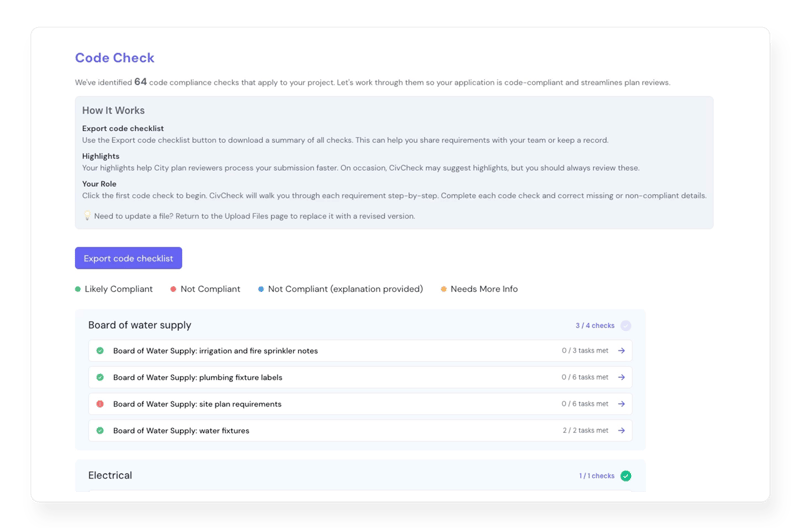
Because intake focuses on completeness and clarity rather than final approval, it's often the lowest-risk and fastest path to value when introducing AI into the permitting process.
Once intake is running smoothly, many permitting departments expand into deeper plan review support.
A reviewer opening a residential addition or ADU project sees the relevant code sections, calculations, and plan locations compiled in one place. Instead of flipping through dozens of sheets and cross-referencing multiple code sections, the reviewer can move directly into verification to confirm what is shown, resolve outlier cases, and make the final determination.
This approach is valuable for high-volume permit types:
As more review groups adopt the platform, the consistency benefits grow. When building, fire, planning, and public works all apply requirements the same way, applicants need fewer corrections at each stage, and applications move through the full process with less rework.
As departments gain confidence, adoption typically expands beyond initial residential or intake-focused processes. Common next steps include:
The most successful implementations treat AI plan review as a platform that grows alongside expanding needs, rather than a solution built around a single permit type.
AI plan review software supports both applicants before submission and reviewers during detailed plan review — working in four steps that together reduce correction cycles and speed up permit issuance.
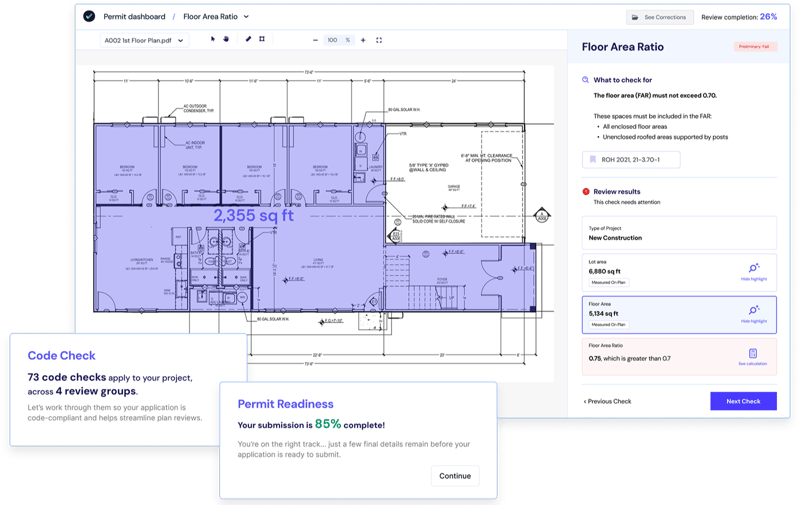
Here's what that looks like in practice.
Before submitting, applicants upload their plans and documents. The platform asks a few questions to determine the project type, then walks them through what's required. It flags missing documents, identifies information that needs to appear on the plans, and highlights where code requirements appear to be unmet. Applicants can address issues before they submit, which means fewer problems once an application enters formal review.
Applicants who have been pre-checked arrive at intake with fewer missing documents and clearer information. For intake staff, this means spending less time on basic completeness triage. For plan reviewers, it means spending less time searching for information and more time evaluating compliance and intent.
Reviewers see relevant code sections, calculations, and plan locations compiled in one place for each requirement. Instead of manually cross-referencing codes and flipping through plan sets, they can move directly into verification. Reviewers still make every determination. The software reduces the time spent getting to that point.
When applicants enter review with clearer, more complete submissions and reviewers are working from the same structured set of requirements, the number of review cycles drops significantly. Permit issuance time decreases, and staff time is redirected to work that requires their expertise.
AI plan review software can be deployed in two ways: as a standalone system or integrated into existing permitting systems. Most jurisdictions start with standalone because it requires no changes to existing processes.
One of the first concerns jurisdictions raise when evaluating AI plan review software is how it fits into their existing systems. Most departments already rely on multiple tools to manage applications, plans, and communications. AI plan review doesn't require replacing those systems to be useful.
| Standalone deployment | Integrated deployment |
|---|---|
|
|
Many jurisdictions start with standalone deployment, which typically has a shorter implementation timeline than a full integrated rollout. It positions AI plan review as part of applicant preparation, not as an added step inside the formal permitting process. The permitting workflow doesn't become longer. Instead, applicants are guided through the work they were expected to do before submitting, now with a clearer structure and instant feedback.
Evaluating AI plan review vendors requires looking past marketing claims to assess accuracy, real-world permitting experience, and whether the platform keeps reviewers in control. As interest in AI grows, more vendors are marketing tools as "AI plan review" — but capabilities, maturity levels, and intended use cases vary widely.
A common misconception in this market is that a platform that looks "futuristic" or "sleek" must be effective at reducing permitting times. Some platforms lean heavily on conversational interfaces (think ChatGPT) or generalized AI models that look impressive in demos but struggle with accuracy, consistency, or explainability in real workflows.
Vendors should be able to explain clearly:
The difference between augmented and artificial intelligence matters more in permitting than most people realize. A platform built around human-in-the-loop decision-making keeps reviewers accountable and in control. One that automates the decisions and asks for confirmation makes accountability hard to track and defend.
| Augmented intelligence | Automated decision-making |
|---|---|
|
|
One way to test this in a demo is to look for what vendors call verification friction, or the degree to which the platform makes it hard to mindlessly accept AI results. A well-designed system should require reviewers to genuinely engage with each check, not just click through.
Look for platforms explicitly designed with a human-in-the-loop approach, where AI reduces the work around a decision, not the decision itself. These platforms have typically applied ethical AI design as a core requirement of their software, not an afterthought.
Accuracy claims can be misleading without context. Two vendors might both claim "faster approvals." One may be referring to speed on a narrow set of automated checks. Another may be referring to overall reductions in permit cycle time. Both statements can be technically true, but they point to different outcomes for your department.
Questions to ask:
Permitting rarely follows a clean, uniform pattern. Local amendments, phased code adoption, additions and alterations, and grandfathered projects all introduce variation in how permits are issued. During evaluation, ask how the platform handles:
These are the most important questions to ask plan review vendors before you buy:
AI plan review isn't a set-it-and-forget-it purchase. The strongest results come from vendors that help permitting departments think through process design, documentation, and change management.
Implementation experience in government permitting is just as important as technical capability. Ask about the backgrounds of the implementation team, how they handle onboarding, and what ongoing support looks like once you're live.
CivCheck's implementation team, for example, includes former plan reviewers, licensed ICC professionals, architects, and professionals with 15–20 years of government permitting experience.
Most demos will show that an AI system can do the job, but to validate whether or not it's suitable for government use, check that it meets the following three must-have criteria:
This is why it's important to ask vendors how long they've been in production, how many jurisdictions are actively using the platform, and how they handle exceptions.
AI plan review software is typically priced based on permit volume, project type, and scope of functionality, with modular models that let jurisdictions start small and expand over time.
Most AI plan review software is priced based on a combination of:
Modular pricing models give jurisdictions more flexibility. Teams can start with a limited scope, such as intake or a single permit type, and expand over time without committing to a full rollout from day one.
CivCheck uses a modular pricing structure so departments can adopt intake and plan review capabilities separately and expand as needed. Pricing is typically tiered by permit volume range rather than exact counts, which helps with budget predictability during procurement.
The return on investment for AI plan review is usually tied to operational efficiency, economic impact, and workforce sustainability, not just direct cost reduction:
Calculate the estimated staff hours and labor costs AI plan review software could save you annually using this ROI calculator.
The more specific your baseline, the easier it is to defend the investment and measure results once the system is live. Compile the following information to help make the internal business case:
Rather than projecting improvements across every permit type, focus initial proposals on one high-volume permit category or on intake. Early wins build confidence and create the momentum needed for future expansion.
Time to value depends on scope, but early adopters of AI plan review software are learning that intake-focused deployments show measurable improvements within weeks of going live. More complicated deployments across multiple departments take longer to configure, but usually deliver compounding benefits as staff adoption increases and workflows stabilize.
In the City and County of Honolulu, CivCheck reduced permit review cycles by 58%, corrections per permit by 67%, and time to permit decision by 55%. Before CivCheck, permits averaged 23.5 corrections per application. With CivCheck, that dropped to 7.7.
Securing approval for AI plan review software typically involves three steps: building internal buy-in, preparing a funding proposal, and navigating procurement. The departments that succeed start by framing the conversation around the operational problem, not the technology.
Gaining support for AI plan review often starts with defining the problem it's meant to solve. Framing the conversation around operational challenges—such as growing backlogs, inconsistent reviews, or staff capacity constraints—helps stakeholders see the technology as a useful tool.
Who to involve early:
Funding proposals share some of the same data as an internal business case, but the focus is on financial specifics. Useful inputs to include:
After budget approval, you may or may not have to go through a formal procurement process. If you do, expect the timeline to range from a few months for a simple process to six months or longer for a full public RFP cycle.
Before issuing an RFP or RFQ, document how plan review is performed today, including local amendments, review group handoffs, and acceptable ways to demonstrate compliance. The more clearly these realities are reflected in procurement documents, the easier it is to evaluate vendor responses against your needs.
Options for streamlining procurement include:
Long-term success with AI plan review depends less on the software itself and more on treating it as part of a broader process improvement that includes technology, process, and people.
AI plan review software needs to adapt to changing codes, policies, and workloads. Choosing a platform that supports ongoing configuration through experienced implementation partners helps ensure the investment continues to deliver value over time.
The most successful projects treat AI plan review as part of a broader permitting process improvement that includes technology, process, and people. The fundamentals haven't changed: start with a clear problem, adopt in phases, and find a partner who understands your operations as well as they understand their own technology.
Ready to see how CivCheck can cut review times and reduce correction cycles in your jurisdiction? Contact our team to schedule a walkthrough. We'll help you determine whether AI plan review is the right fit, where to start, and what results are realistic for your specific situation.
Accuracy varies by platform and check type. Real-world engagements give the clearest picture: in Calgary, CivCheck achieved 93% accuracy on zoning compliance checks and 94% on document completeness across 30 bylaw regulations. In Seattle, CivCheck achieved 92% accuracy against human reviewer decisions across more than 1,200 checks. When evaluating vendors, ask for performance data from live deployments or structured engagements — not just demos — and ask how accuracy is measured for specific check types.
No. AI plan review is designed to support reviewers, never replace them. Reviewers still evaluate intent, handle rare cases, and make every final determination. The software reduces time spent on information gathering so reviewers can focus on the decisions that require their expertise.
Intake-focused deployments can go live in weeks. More complex rollouts across multiple departments and permit types take longer, but most jurisdictions see measurable results within the first few months.
It depends on the platform. Some require custom development to reflect local amendments, which adds cost and time. Others use configuration-based approaches that can be updated more quickly. Ask vendors specifically how they handle local amendments and whether there's an additional cost.
Yes, when the platform is built with transparency and human oversight in mind. Ask vendors whether reviewers can see where every answer came from, whether the platform applies requirements consistently, and whether final decisions stay with qualified staff. A conversation with the vendor about how they handle exceptions will tell you a lot about their platform's safety.
Most platforms price based on permit volume, project type, and scope of functionality. Costs vary, but modular pricing models allow jurisdictions to start with intake or a single permit type and expand over time. For budget planning purposes, ask vendors for tiered pricing ranges rather than exact per-permit costs.