


Enterprise
Permitting software for large local governments.
If you’re trying to accelerate your permit approval times, you’ve probably heard of automated code compliance tools as a potential solution.
But despite being marketed as “AI for permitting,” these tools aren’t capable of shortening permitting times on their own.
And not because the technology doesn’t work or isn’t useful. It does. And it is.
But because the real drivers of permitting delays aren't usually design violations. They're incomplete submittals, missing documents, absent calculations, or local requirements that weren't met.
This isn’t to say that automated code compliance tools aren’t useful. They’re just not effective if your goal is to reduce permit review times, because they’re not actually permitting tools. They’re design aids.
What automated code compliance tools are useful for is helping architects and permit applicants:
So if your goal is faster permits, these solutions can help, but only when paired with tools and processes that actually address what slows reviews down.
Imagine you’re reviewing this submission as a building official. Would you issue a permit?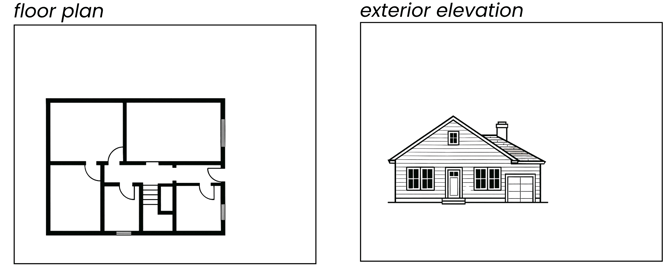
Probably not. Because there are no supporting documents, dimensions, calculations, callouts, or annotations. So even if the design appears to meet code, there’s no way to verify that from the submission itself.
And permits aren’t approved based on what the designer knows or whether or not a design appears code compliant. They’re approved based on permit documents that clearly demonstrate compliance in the way reviewers expect.
Even when two jurisdictions adopt the same building code, they often expect compliance to be demonstrated in very different ways.
In one city, a signed affidavit might be enough to confirm a drainage requirement. In another, that same code section may require detailed calculations, diagrams, and an engineer’s stamp.
Much of permitting complexity comes from documentation requirements, not the underlying code. And automated code compliance engines are simply not designed to interpret or meet these jurisdiction-specific expectations.
So you end up with the same amount of comments, corrections, and resubmittals whether these tools are used or not.
Rather than seeing a reduction in staff workload after implementing automated code compliance into their permitting workflows, cities like Singapore and Mumbai instead saw the work shift to someone else, because these tools have limitations.
They require highly structured, standardized BIM models (when real architectural files vary widely and rarely meet those formats), and reviewers still need documentation to be presented according to local conventions.
So over time, this led to consultants being hired solely to rework models so automated systems could interpret them.
The work didn’t go away. It just moved to a new step.
Most permit delays don’t happen because a design breaks the code. They happen because of issues like:
And none of these issues are visible to automated code compliance engines.
Permitting moves faster when applicants submit complete, well-documented, locally compliant plans on the first attempt.
That means:
Tools that help applicants improve their permit documents, not just their design model, are the ones that meaningfully reduce review times.
AI permit preparation tools like CivCheck focus on exactly this: improving the quality and completeness of submittals so projects pass in fewer rounds. By scanning draft submissions for everything a plan reviewer evaluates, these tools lead to higher-quality plans, fewer resubmittals, less intake back-and-forth, and ultimately fewer applications to process.
For a full comparison of AI tools for permitting and what actually reduces review times, see our AI plan review software buyer's guide

