
Guided AI Plan Review Software
Approve permits faster with AI that guides applicants to a complete and compliant submission and staff through every check.
Faster permit approval
Decrease in review cycles
Code interpretation accuracy
Code books covered
Reducing permit backlogs is hard. CivCheck makes it easier.
CivCheck's AI copilots help reduce submission errors and 10x staff productivity.
Applicants submit their permit documents to CivCheck's guided applicant portal for AI to pre-check.
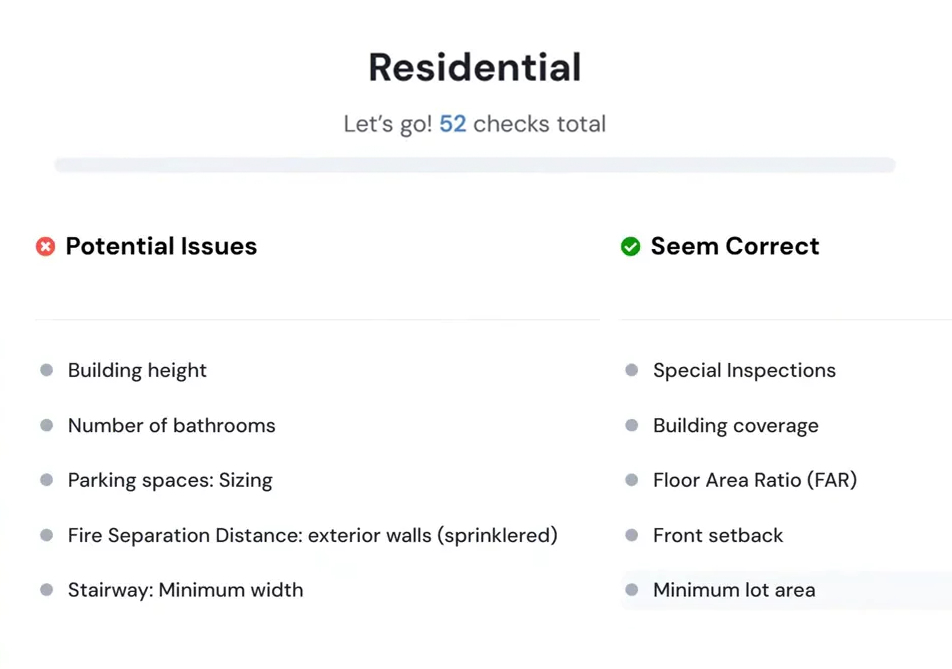
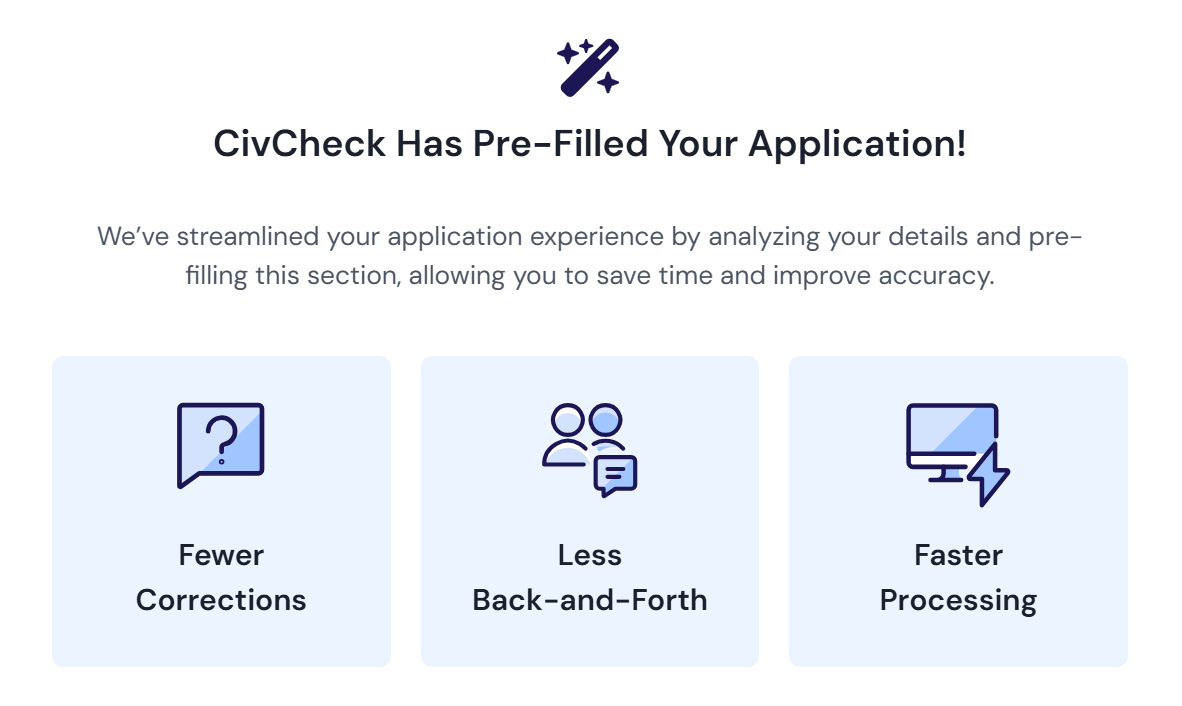
AI flags any issues and guides applicants on how to fix them so their application is approvable and ready for staff review.
Applicants submit their pre-checked, complete, and compliant application to the city for review.
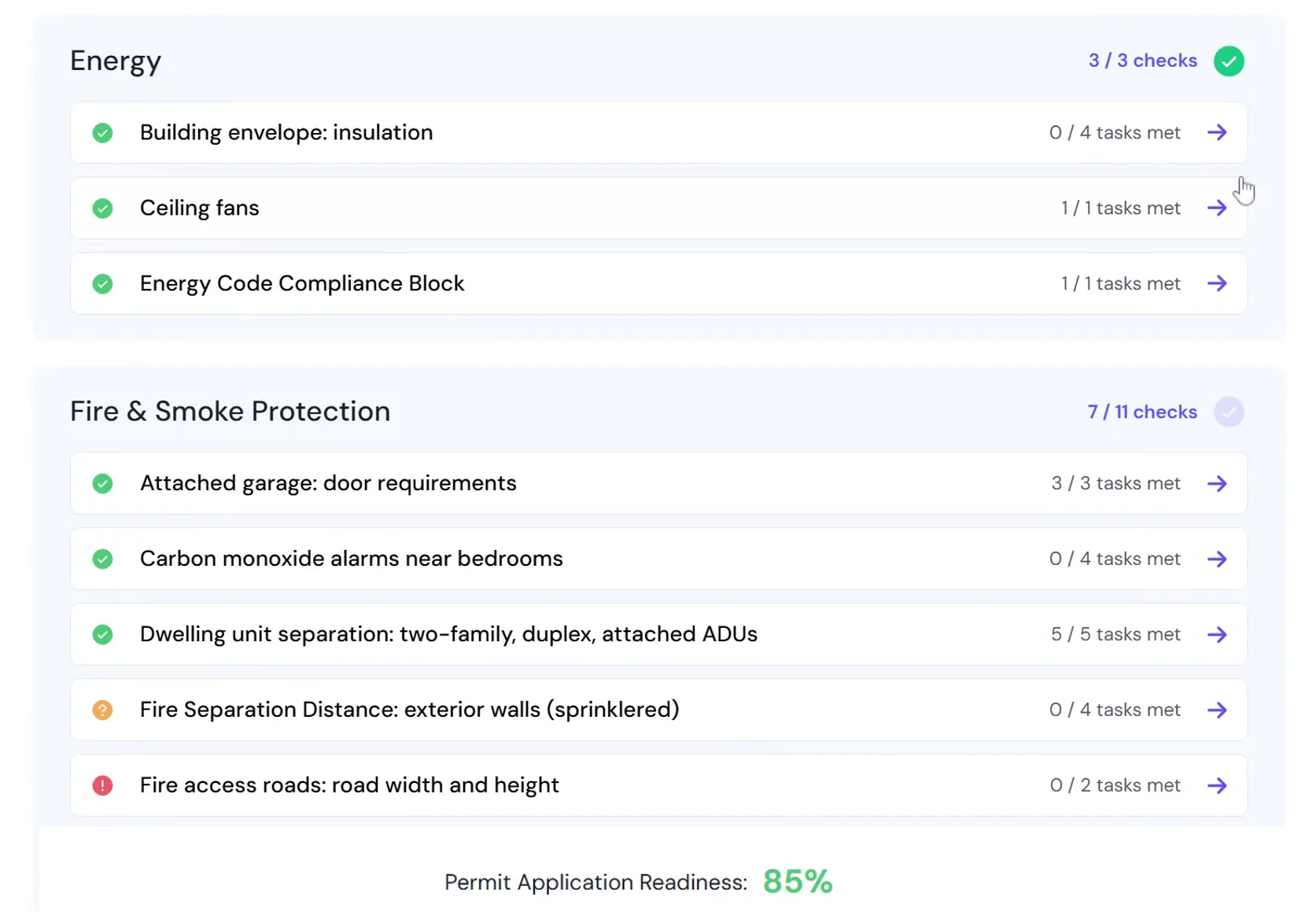
Staff receive the application along with AI pre-check information, calculations, and codes to reference during their review.
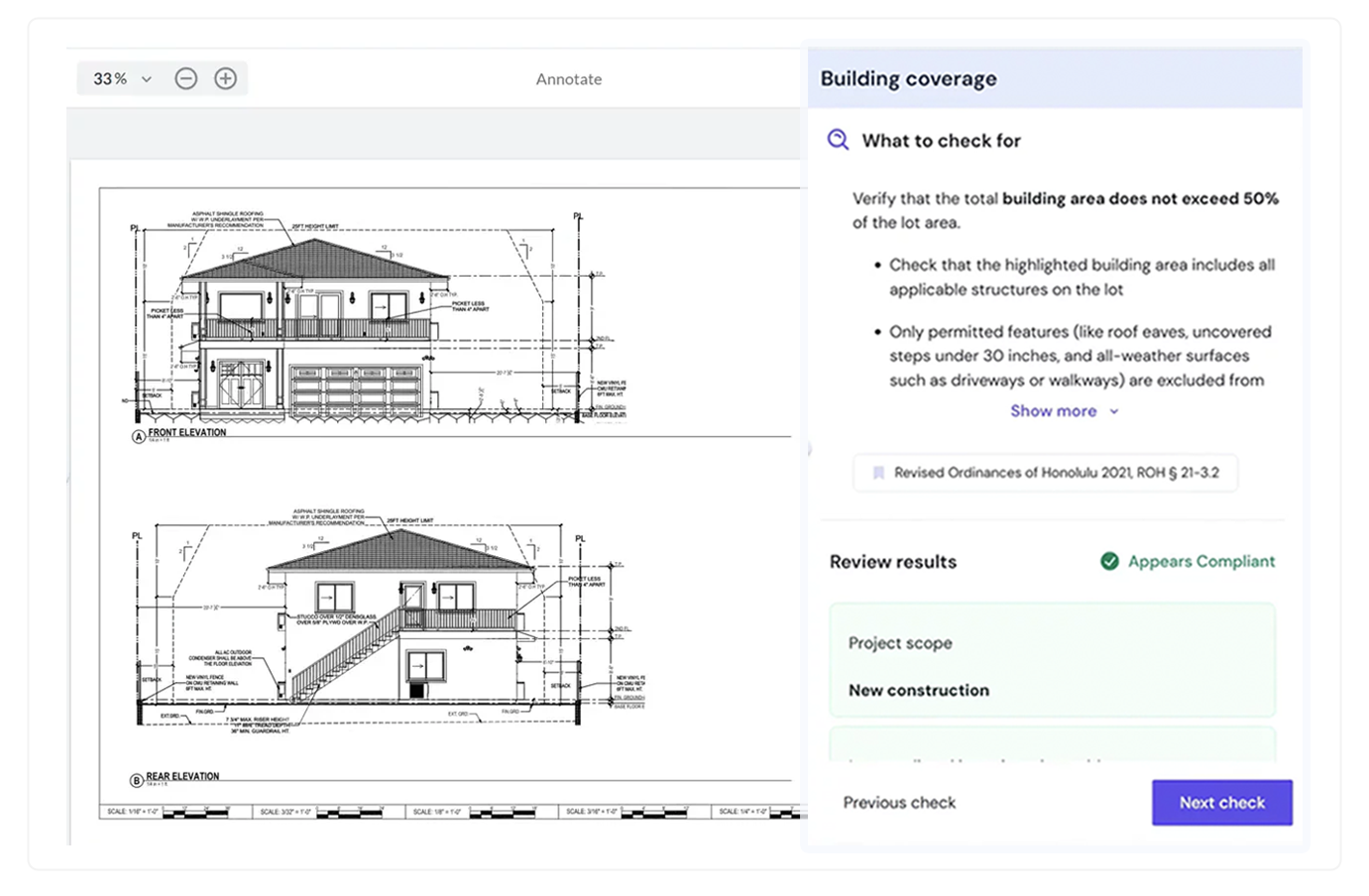
CivCheck's AI-powered validation tool guides staff through their review, flagging areas that need attention and the 'why' behind every AI interpretation.
Plan reviewers get through their reviews up to 90% faster.
Why guided AI plan review?
AI stops incomplete and non-compliant permit applications from reaching your queue. Staff review and sign off on every AI interpretation. Reduce your permit approval time in as little as one week.
AI does a first-pass review — staff sign off on every interpretation
CivCheck requires staff to approve every AI interpretation, ensuring faster reviews without sacrificing accuracy or accountability. Every staff correction also trains the system to get smarter over time.
AI supports every check a plan reviewer does
CivCheck's AI checks for application completeness and code compliance across every review discipline, not just a subset of codes. Everything a plan reviewer looks for, CivCheck's AI reviews first.
Purpose-built for local government permitting
Because CivCheck was designed for local governments, it naturally fits into existing plan review and permitting workflows with minimal configuration required to go live.
Go live in weeks, not months
See a reduction in your permit approval time in as little as 1 week. CivCheck's permit intake module can be implemented in 40 hours or less, and the full platform in just a few weeks.
Works with PDFs, forms, and hand-drawn plans
CivCheck is natively built to work with every document type applicants submit, so everybody can use it — not just those with the right tools.
Make system updates in minutes
When codes, regulations, and requirements change, CivCheck can be updated in real time — no costly reconfiguration, no delays.
AI catches errors before they reach your queue — and guides staff through every check.
CivCheck works on both sides of the permitting process — guiding applicants to submit complete, compliant applications, and staff through every review. Together, the two modules cut review cycles from an average of 3–6 down to 1–2.
Guided AI Permit Intake
- AI guides applicants through every requirement so submissions arrive complete and permit-ready
- AI-powered staff portal flags issues and speeds up intake review and routing
Guided AI Code Compliance
- AI copilot walks applicants through code requirements before they submit
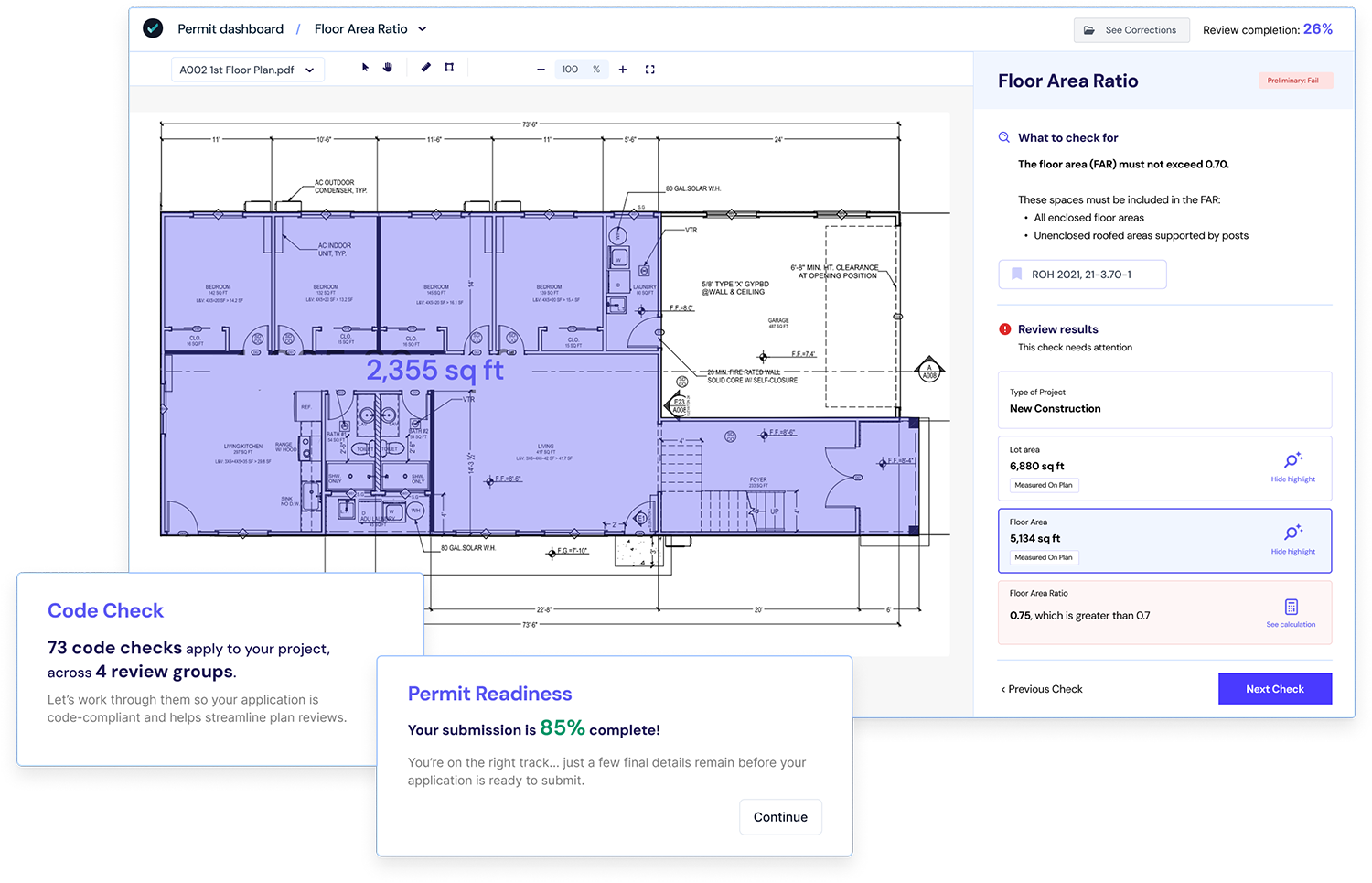
- Staff get pre-check calculations, code references, and flagged issues on one screen
The AI plan review tools that help you approve permits faster
-
Universal File Uploads
Applicants can upload all types and formats of permit documents, including construction drawings, forms, and even hand-drawn sets. No reformatting or manual tagging needed.
-
Guided AI Completeness Checks
CivCheck flags missing documents and incomplete information before applicants submit for staff review — eliminating the most common cause of review delays before they start.
-
Guided AI Code Compliance
CivCheck walks applicants through every review discipline, flagging compliance issues and explaining exactly what reviewers are looking for and why — so submissions arrive complete, compliant, and approvable the first time.
-
Intelligent Plan Navigation
Jump straight to the exact section of the plan or form you need without scrolling or searching. CivCheck highlights the right data so you can make decisions in seconds.
-
Automatic Code-Based Calculations
CivCheck automatically calculates capacities, loads, dimensions, ratios, and more using relevant, project-specific codes to save you time. Each calculation also comes with a step-by-step breakdown so you can verify the results.
-
Digital Code Library
Easily pull up relevant code links and plain-language summaries for every check. With a click, reviewers can figure out what they need to look for and why it matters.
Dawn Takeuchi Apuna
Director, Department of Planning and Permitting, City and County of Honolulu
"Instead of just submitting plans into an AI machine, CivCheck guides the applicant, helping them understand what's missing or non-compliant, which cuts down the number of review cycles."



See how cities make faster permit decisions with CivCheck
Case Study
Honolulu Cuts Review Times by 70% with CivCheck's AI Plan Review Software
Read case study →
Case Study
How CivCheck's Guided AI Plan Review is Helping Seattle Address Permit Delays
Read case study →
Case Study
How Calgary is Using AI to Bring Consistency to One of Canada's Most Complex Zoning Frameworks
Read case study →
Buyer's Guide
AI Plan Review Software: A Buyer's Guide for Permitting Departments
Everything you need to evaluate AI plan review software — what to look for, questions to ask vendors, and how to build the case internally.
Read the guideFrequently asked questions
CivCheck is designed for jurisdictions looking to improve their permitting process using AI. It's a two-sided solution: on the applicant side, CivCheck's AI walks applicants through every step needed to make their submission complete, compliant, and permit-ready before it reaches your queue. On the staff side, the platform's AI co-pilot guides each reviewer through a discipline-specific review experience — enabling faster, more consistent reviews across your team.
CivCheck provides the most value for jurisdictions where volume or application quality are the primary drivers of permitting delays. If delays stem from unclear policies, missing steps in your internal process, or coordination issues between departments, those are process problems that technology alone won't fix — and should be addressed before or alongside implementing AI plan review.
Not sure which applies to your situation? Our AI plan review software buyer's guide walks through what to look for and how to assess whether your department is ready.
CivCheck is designed to work on both sides of the process — and that's intentional. The biggest driver of long review times and permit backlogs is poor-quality submissions. So in order to actually speed up turnaround times, incomplete and non-compliant applications need to be addressed before they reach your queue.
By guiding applicants through the requirements before they submit, CivCheck reduces the back-and-forth that consumes most of a reviewer's time. Once a complete and compliant submission reaches your queue, the staff portal then makes it significantly faster to complete the review. The two sides work together to cut review cycles from the typical 3–6 down to 1–2.
When an applicant submits through CivCheck, they're guided through the city's requirements in stages. The platform first checks for scope and completeness, flagging missing documents and required information before the applicant goes any further. It then works through code compliance checks stage by stage, giving the applicant instant or near-instant feedback and the opportunity to address issues before submission.
The goal is to help applicants prepare a submission that's permit-ready. Staff review and sign off at every stage, so the city maintains full oversight throughout.
CivCheck supports every check a plan reviewer performs — not just a subset of codes. During pre-screening, the platform checks for code issues across every review discipline, including zoning, building, fire, accessibility, plumbing, structural, and more.
CivCheck is PDF-native, so applicants can submit hand-drawn plans, required forms, and all standard permit documents. No BIM or specialist software required.
CivCheck achieves industry-leading accuracy rates of 98%+ — and the reason is our human-in-the-loop approach. Every step the AI takes, an applicant or staff member verifies and can override. This means errors never compound.
If the AI isn't confident in a result, it won't make a guess. Instead, it prompts the user to provide or manually verify the information. The underlying principle is that AI should never make a decision directly. It should help a human make a better decision, faster.
CivCheck is not built from scratch for each city. We maintain a growing library of pre-configured templates based on major code families — including the CBC, CRC, and other widely adopted base codes — so implementation starts from a strong foundation rather than a blank slate.
From there, we gather what your department actually enforces in practice, which is typically 200–250 critical life-safety and health-safety checks, not the entire code book. We then fine-tune those checks to reflect your exact compliance standards. For example, two cities reviewing the same state drainage requirement may require applicants to present it differently: one requires an affidavit, another requires detailed calculations shown on plan. CivCheck maps to exactly how your reviewers enforce it.
The result is a platform that's pre-trained enough to accelerate implementation, but customizable enough to reflect how your team actually works.
Updates can be made directly in CivCheck's Rules Management System in as little as 2–3 minutes. We prefer to allow around 24 hours for testing and validation before releasing a change, and grace periods are fully supported for jurisdictions that need transition time between old and new requirements.
Because CivCheck maps to exactly how your department enforces each requirement — not just the base code — updates reflect your local enforcement standards, not a generic interpretation.
CivCheck is faster to implement than you'd expect. Completeness checks, intake requirements, and structured reviewer guidance can be configured in as little as a few weeks if your department has strong documentation. Code compliance checks for residential permits are typically ready for testing within a few months of project kickoff.
The City and County of Honolulu followed this same timeline. After implementation, their total review time dropped by as much as 90%, with residential plan reviews going from 90 minutes to as little as 15.
Yes. CivCheck can integrate with all major cloud-based permitting solutions, including permitting software, electronic plan review tools, GIS, and identity and access management systems.
That said, many cities start with CivCheck as a standalone product first — it sits before the official submission process and is quick to implement. Integrations can be phased in later once you've seen how it works in practice and know exactly what you need. Either way, the option is there when you're ready. And if you're currently mid-implementation on new permitting software, CivCheck can integrate with your incoming system too.